
Usage of Kampo Medicine by Physicians in Japan
Overview
Japan is the only country where herbal medicine, known as Kampo medicine, is fully integrated into the Western healthcare system and prescribed by physicians under the national health insurance system. Recently, more clinical data and case studies have been presented by physicians, demonstrating its effectiveness and integration within contemporary medical practices.
This unique integration has not only generated valuable clinical data on the combination of the two types of medicine but also provides patients with a wide range of treatment options and comprehensive medical care that combines the benefits of both medical traditions. Here, we provide insights from two different surveys conducted among physicians regarding the usage of Kampo medicine in 2024, 2017 and 2011.
Survey in 2024
- 87.4% of Japanese physicians regularly prescribed Kampo medicine.
- 60% of physicians use Kampo medicine because it has been effective in cases where Western medicine treatments were ineffective
Survey in 2017
- 81.2% of Japanese physicians regularly prescribed Kampo medicine.
- Prescribing rates were consistent across age groups and specialties.
- 43.8% of Kampo-prescribing physicians used it for less than 10% of patients.
- Most physicians utilized four or fewer Kampo formulas.
Survey in 2011
- 89% of Japanese physicians regularly prescribed Kampo medicine.
- 83% used it alongside Western treatments, with a 1:9 ratio.
- 59% considered Kampo as their first-choice treatment.
- Reasons for prescribing Kampo included its efficacy for conditions Western medicine couldn’t treat (57%), patient demand (43%), and supporting studies (34%).
Survey details
Kampo Medicine Prescription Survey in 2024
- Survey Period: 3/26 – 3/29 2024
- Target Audience: 342 Japanese physicians
- 342 Japanese physicians
- Method: Online survey
A survey conducted by Varytex Co., Ltd. on the Kampo medicine use survey among Japanese physicians who are non-Kampo specialists revealed that 87.4% of them regularly prescribe Kampo medicine. Additionally, 88.9% of these physicians expressed a desire to use advanced technologies, such as Kampo diagnosis support software, as a means to address issues related to Kampo prescriptions, demonstrating a significant demand for such solutions.
Kampo Medicine Prescription Survey in 2017
- Survey Period: 3/7 – 3/13 2017
- Target Audience: 975 Japanese physicians
- Demographics: 237 self-employed physicians, 738 employed physicians
- Method: Online survey
In the Kampo medicine use and satisfaction survey of Kampo Medicine conducted by M3, Inc., which is the largest Japanese Healthcare Professional Exclusive Website, 81.2% of M3’s physician members, totaling 792 individuals out of 975, reported prescribing Kampo medicine in their practice.
While Kampo medicine has a long history, it wasn’t included in the medical education model as a core curriculum in medical schools until the 21st century. The purpose of this survey was to uncover the real situation of Kampo medicine prescribing practices in routine clinical care. To achieve this, physician members were asked a three-choice question.
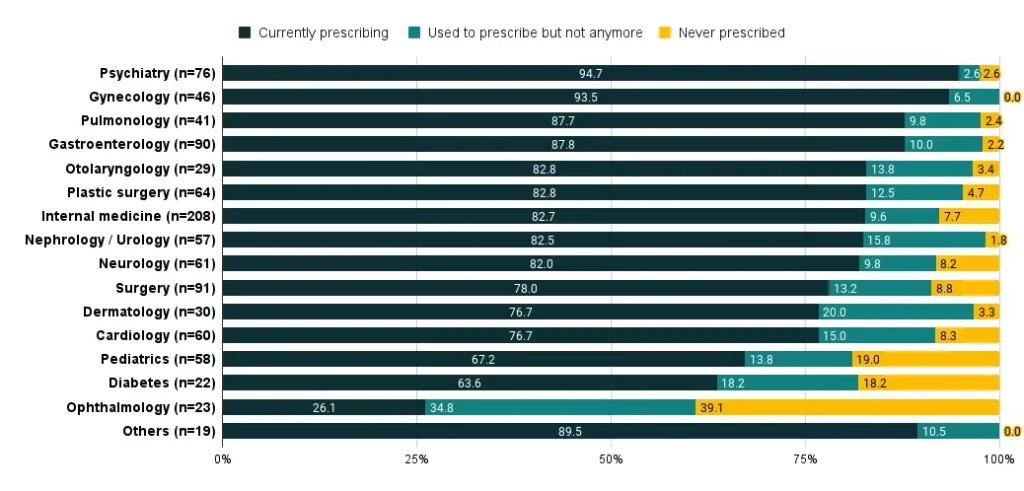
Q1: Are you currently prescribing Kampo medicine?
Among the total 975 physicians, 81.2% reported prescribing Kampo medicine, 11.7% mentioned that they had prescribed it in the past but were not currently doing so, and 7.1% stated that they had never prescribed it. When categorized by occupation, 85.7% of private practice physicians (237 individuals) and 79.8% of hospital-based physicians (738 individuals) prescribed Kampo medicine.
In terms of age groups among physicians, the survey showed that the prescribing rates were quite similar across different generations, with all age groups having a prescribing rate exceeding 80%. To be more specific, it was 81.1% for those under 35 years old (122 physicians), 81.9% for those aged 35 to under 50 (354 physicians), 80.9% for those aged 50 to under 65 (424 physicians), and 80.0% for those aged 65 and older (75 physicians).
In terms of medical specialties, Psychiatry (76 physicians) at 94.7% and Obstetrics and Gynecology (46 physicians) at 93.5% had prescribing rates more than 10% higher than the overall average. Conversely, Ophthalmology (23 physicians) at 26.1%, Endocrinology, Metabolism, and Hematology (22 physicians) at 63.6%, and Pediatrics (58 physicians) at 67.2% had prescribing rates more than 10% lower than the overall average.
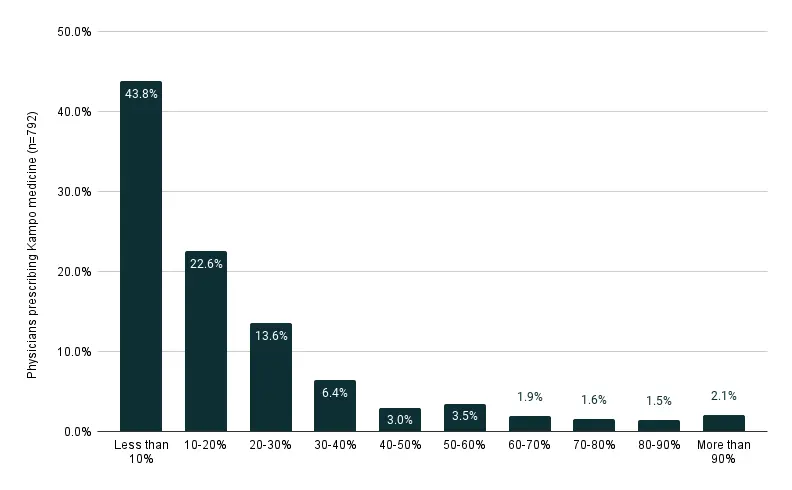
Q2: For those who answered “currently prescribing” to Q1, what % of patients receiving oral medications are prescribed Kampo medicine?
Among the physicians who responded that they are currently prescribing Kampo medicine (792 physicians) answered that 43.8% of them prescribed Kampo medicine to “less than 10%” of their patients. 22.6% was “10% – 20%”, 13.6%, was “20%-30%”. There were no significant differences observed between private practice physicians (203 individuals) and hospital-based physicians (589 individuals).
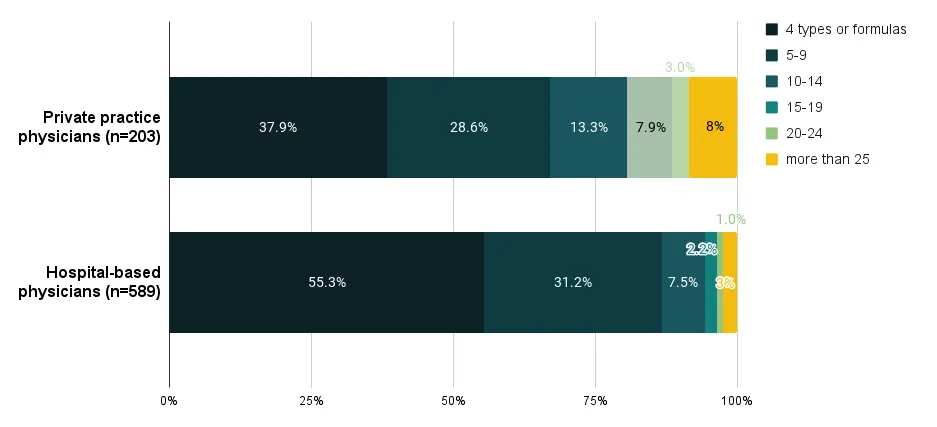
Q3: For those who responded “currently prescribing” to Q1, how many different types of Kampo medicine do you use?
Among the physicians who responded to Q1 (792 physicians), 50.9% responded with “4 types or formulas or fewer,” followed by 30.6% who answered “5-9 formulas,” and the third highest response was “10-14 formulas” at 9.0%.
Between private practice physicians (203 individuals) and hospital-based physicians (589 individuals), both groups predominantly prescribed “4 types of formulas or fewer.”
Kampo Medicine Prescription Survey in 2011
- Survey Period: 8/30 – 9/5 2011
- Target Audience: 627 Japanese physician
- Method: Online survey
In another survey conducted by Intage Health in 2011, which involved 627 physicians, it was found that 89% of physicians in Japan regularly prescribed Kampo medicine to their patients. Moreover, 83% of Japanese physicians used Kampo medicine as complementary medication alongside Western treatments, with a ratio of Kampo use to Western Medicine being 1 : 9. Additionally, 59% of Japanese physicians chose Kampo as their first-choice treatment, often based on recommendations from their peers who also prescribed Kampo medicine to their patients.
| 2008 | 2011 | |
| Currently using Kampo medicine | 83.5% | 89% |
| Choose Kampo medicine as the first choice | 52.7% | 59% |
| Treatment is highly effective | 43.4% | 52.2% |
| Level of satisfaction is high | 49% | 53.6% |
| Treatment is not sufficiently effective | 32.7% | 23.2% |
| Evidence is not sufficient | 39.8% | 34.8% |
The primary reasons for starting to prescribe Kampo medicine include that it can treat diseases that Western medications didn’t work, cited by 57% of respondents. Additionally, 43% mentioned the strong demand from patients as a motivating factor, and 34% pointed to studies demonstrating its effectiveness. 31% of respondents indicated that they turned to Kampo medicine due to inherent limitations in Western medicine.
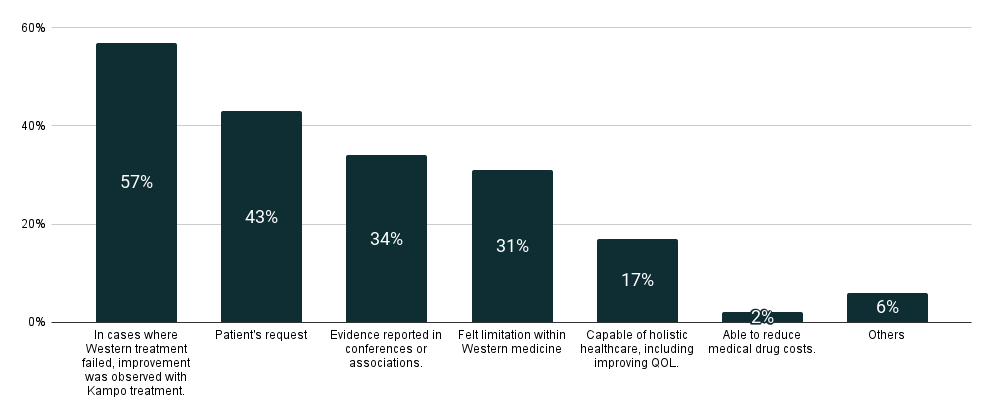
Q1: Why did you start prescribing Kampo medicine?
In conditions or symptoms where herbal medicine is prescribed.
Among the physicians who responded that they are currently prescribing Kampo medicine (792 physicians) answered that 43.8% of them prescribed Kampo medicine to “less than 10%” of their patients. 22.6% was “10% – 20%”, 13.6%, was “20%-30%”. There were no significant differences observed between private practice physicians (203 individuals) and hospital-based physicians (589 individuals).
Further Research on Leading Kampo Prescriptions and Trends
Survey 4
- Conducted by Nikkei Medical Custom Publishing in 2024
- Kakkonto/Ge Gen Tang (70.2%), followed by Daikenchuto/Da Jian Zhong Tang (50.2%) and Shakuyakukanzoto/Shao Yao Gan Cao Tang (49.2%) were the most frequently prescribed.
- Notably, Daikenchuto/Da Jian Zhong Tang, Rikkunshito/Liu Jun Zi Tang, and Yokukansan/Yi Gan San saw a substantial increase in usage due to accumulating scientific evidence supporting their effectiveness.
Survey 5
- Conducted by Japan Medical Data Center, a large claims database in 2005 – 2016
- Shakuyakukanzoto/Shao Yao Gan Cao Tang, Kakkonto/Ge Gen Tang, and Daikenchuto/Da Jian Zhong Tang were the most commonly prescribed.
In conclusion, while the distribution of physicians using Kampo varies widely by specialty, it is valuable to learn how each medical field integrates Kampo into its practice because the integration of Kampo medicine demonstrates its efficacy and adaptability alongside Western medicine. Surveys from the past decades highlight that a significant majority of Japanese physicians regularly prescribe Kampo in order to complement Western treatments. The efficacy of Kampo medicine depends on the dosage, ratios, the quality of herbs, and the combinations of these herbal ingredients. Consequently, even for the same symptoms, different formulations of Kampo medicine can lead to varying outcomes.
This post was originally published on kampo.care and has now been moved to kampo.us.